
The Millennia (2001) Mathis Lidice (Félix Fernando Baños López), Puerto Vallarta Malecon
Summary
- The Millennia is a spiral sculpture located on the north side of the Malecon, it was created by Mathis Lidice in 2001.
- It features figures representing animal evolution, Charlemagne wielding a sword, Nezahualcóyotl, and a woman stretching up to the future.
- The sculpture is located near Hotel Rosita, at the beginning of the Malecón.
- The sculpture is visually striking and serves as a reminder of the rich artistic culture of Puerto Vallarta.


Introduction
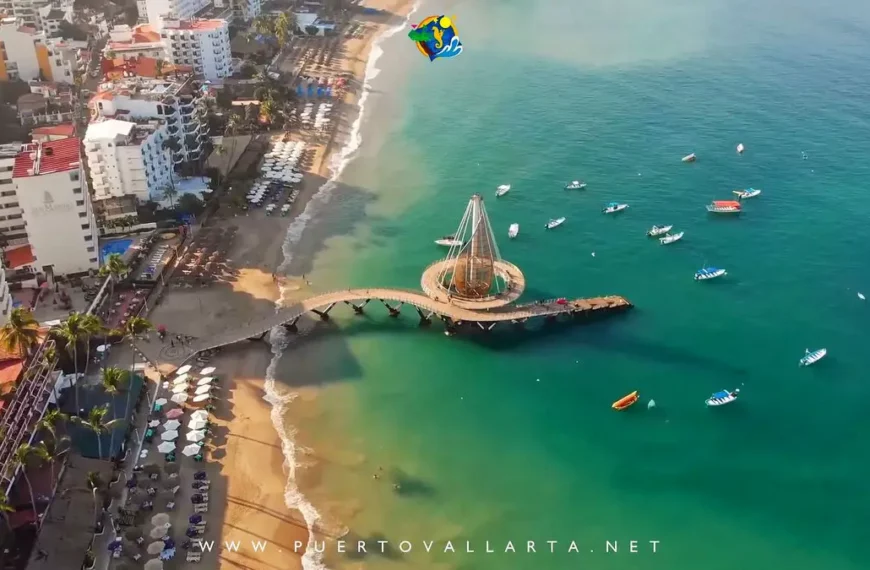
This impressive spiral sculpture starts off the Malecon on the north side, a piece that represents life, evolution, time and human development.
This large bronze spiral sculpture is right beside one of the oldest hotels in town, Hotel Rosita, right by the edge of the sea. This was the prior location of the mouth of Los Coamecates brook, a location where ships were loaded and unloaded by hand before the harbor area was established in the 1960s.

The Millennia “Los Milenios” (2001) Mathis Lidice
The Los Milenios sculpture (The Millennia) was created by Mathis Lidice (Félix Baños) and weighs 1750 kilograms (2860 lb). You’ll find it on the southwest corner of Hotel Rosita, at the northern end of Puerto Vallarta’s Malecon (boardwalk).
The piece was created to celebrate the new millennium and is full of symbolism and meaning. It was sculpted on December 16, 2000, and was unveiled at its present location on October 31st, 2001.
Description
The sculpture’s spiral form symbolizes the passage of time, but on the sculpture itself, you are shown various elements that give a clearer idea of the message the artist, Mathis Lidice, is trying to convey.

The Millennia sculpture base: “Mathis Lídice, Miércoles 16 de Diciembre del 2000”
At the base waves, water, the sea, where the original life appeared, a little further up a strand of DNA and from there an explosion of life and evolution, both natural and human, the base ends with symbols that represent the presence of Christ in history, on the front sun and on the back various other symbols, including a pair of hands lifted in prayer.
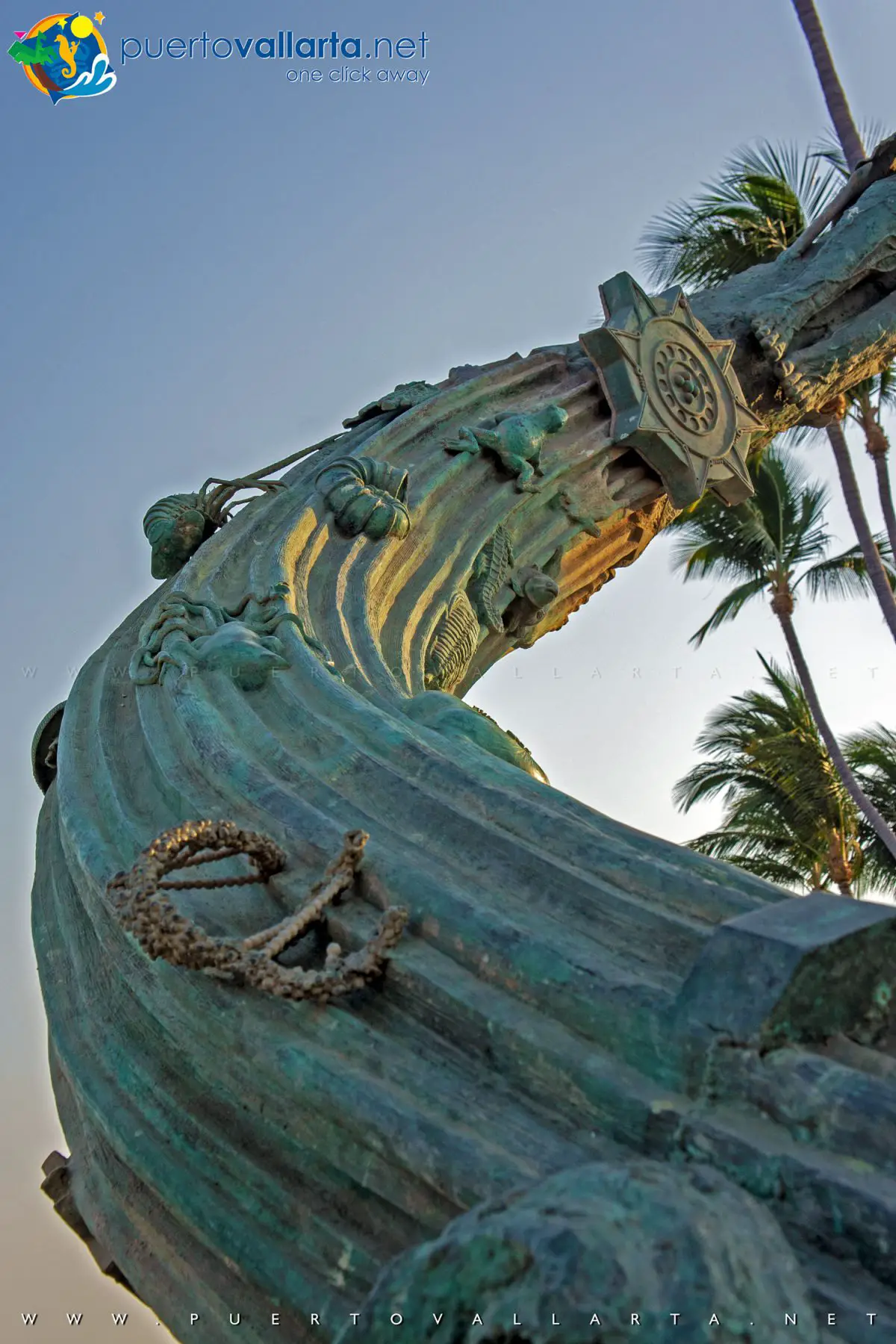
Evolution and the origin of life, The Millennia, Mathis Lidice, Malecon
In the second part, you can see a warrior, Charlemagne (Charles the Great), king of the Franks from the VIII and IX century and founder of Europe, a model for this, the first millennium, encircled in flames, that emphasizes the violence and upheaval those 1000 years brought.

Charlemagne (Charles the Great) Carlomagno, The Millennia
The second millennium is represented as a symbol of universal wisdom by poet king Nezahualcóyotl from the XV century, holding a lithium atom (Bohr’s atomic model) in his right hand (the discovery of atomic power) and with his left pointing to a sphere with America on one face and the dark side of the moon on the other, symbolizing the great discoveries in those 1000 years (the discovery of America in 1492 and when men walked on the Moon in 1969), but his face in decay also symbolizes that technology and philosophies have, in fact, also been used to destroy and kill as never before in history.

Nezahuacóyotl and Quetzalcoatl, Malecon, Puerto Vallarta
Quetzalcóatl, the feathered serpent, a symbol of wisdom unites the second millennium to the third.
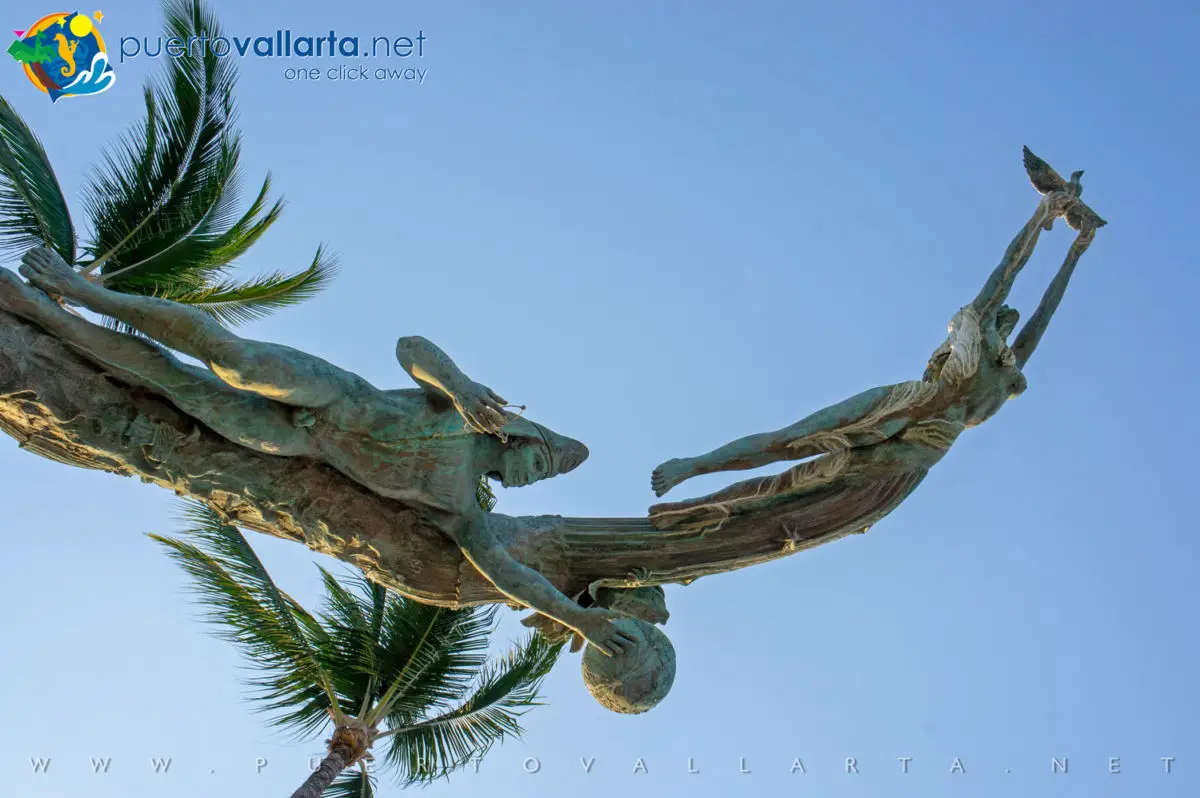
The Millennia by Mathis Lídice, Malecon Puerto Vallarta
The third and last millennium is symbolized by a woman trying to catch a dove (a peace dove), a wish that maybe, finally, in this third millennium all countries will attain their rightful place, women will obtain corresponding rights and together will once and for all attain the idealized goal of humanity: peace.

360° View of The Millennia (2001) Mathis Lidice


In the Artist’s Words (Mathis Lidice/Félix Fernando Baños)
What does “The Millennia” represent and mean?
The bottom part of The Millennia sculpture symbolizes the time before Christ and the origin of life, some scientists have theorized that life started in underwater volcanoes, so the spiral of life starts off there and ends with the symbols of Christ going up the sculpture.

Charlemagne (Charles the Great)
The three top figures on the sculpture represent the three millennia following Christ; initially, these characters were anonymous, but the author decided to choose one representative individual from each of these millennia based on his research before to sculpting the piece. So the first one, Charlemagne (Charles the Great), was chosen based on his vision of the future; he was an exception among the other greats of the time because he believed the Roman Empire would not last forever and would eventually disappear, as it did, and he created the replacement, Europe, which has lasted to the present day.

Origin of life, evolution and the start of the First Millennium with Christ and Charlemagne
Netzahualcóyotl
The second millennium is represented by Netzahualcóyotl, the wise poet king who participated in all aspects of his time, symbolizing the millennium’s cultural richness.
He has the symbol of a lithium atom in his right hand, representing the intimate knowledge of the matter that was obtained during this period. His left hand points to America, representing the encounter and discovery of this new world, as well as to the dark side of the moon, another great achievement during this time period, when men set foot on the moon’s surface and conquered space.
Life and death are also symbolized on the face of this king, the duality that represents the controlling principle of the universe in the indigenous mentality. The Second Millennium also shows a lot of this duality; together with the highest triumphs of humanity, we also participated in the worst atrocities: the two World Wars, the atomic bomb, complete cities destroyed, etc. So Netzahualcóyotl’s face also symbolizes life and death.
Quetzalcóatl, the feathered-serpent
In principle, Quetzalcóatl is the God of Wisdom, but the tail is from a rattlesnake and the feathers of the neck are puffed up, like the Quetzalcóatl sculptures at Teotihuacan, this is the way the artist tells us that along with wisdom, death and struggle, the conflict, are also brought over into the third millennium.

The Millennia (Los Milenios), Mathis Lídice (Felix Baños), Malecon Puerto Vallarta
Women and the Future
Finally, the third millennium is symbolized by a woman, the idea was that if I was using the human body to represent The Millennia, a woman was needed to include all of humanity, but even more importantly the best representation of the future, in human symbols, is the woman, she is the bearer of life, the giver of life. It also represents the artist’s wish that women finally will become equal to men, not a copy of man as some women pretend, rather, that women develop their specific capabilities as have men with their own. The model used for this symbol was Noemí Deyanira Gómez López, Miss Puerto Vallarta and Miss Jalisco, that way a Vallarta woman would represent the third millennium, flying toward downtown Puerto Vallarta, trying to catch the peace dove, showing that the whole sculpture, a bit like a serpent, is finally just a search for peace.
Location Map of The Millennia
You’ll find this statue at the north end of the Malecon, on the SW corner of Hotel Rosita, at the end of 31 de Octubre street in downtown Puerto Vallarta.
The square where the statue is located was designed to honor the builders of Teuchitlan, Jalisco, the only Mesoamerican city with round pyramids called Guachimontones.
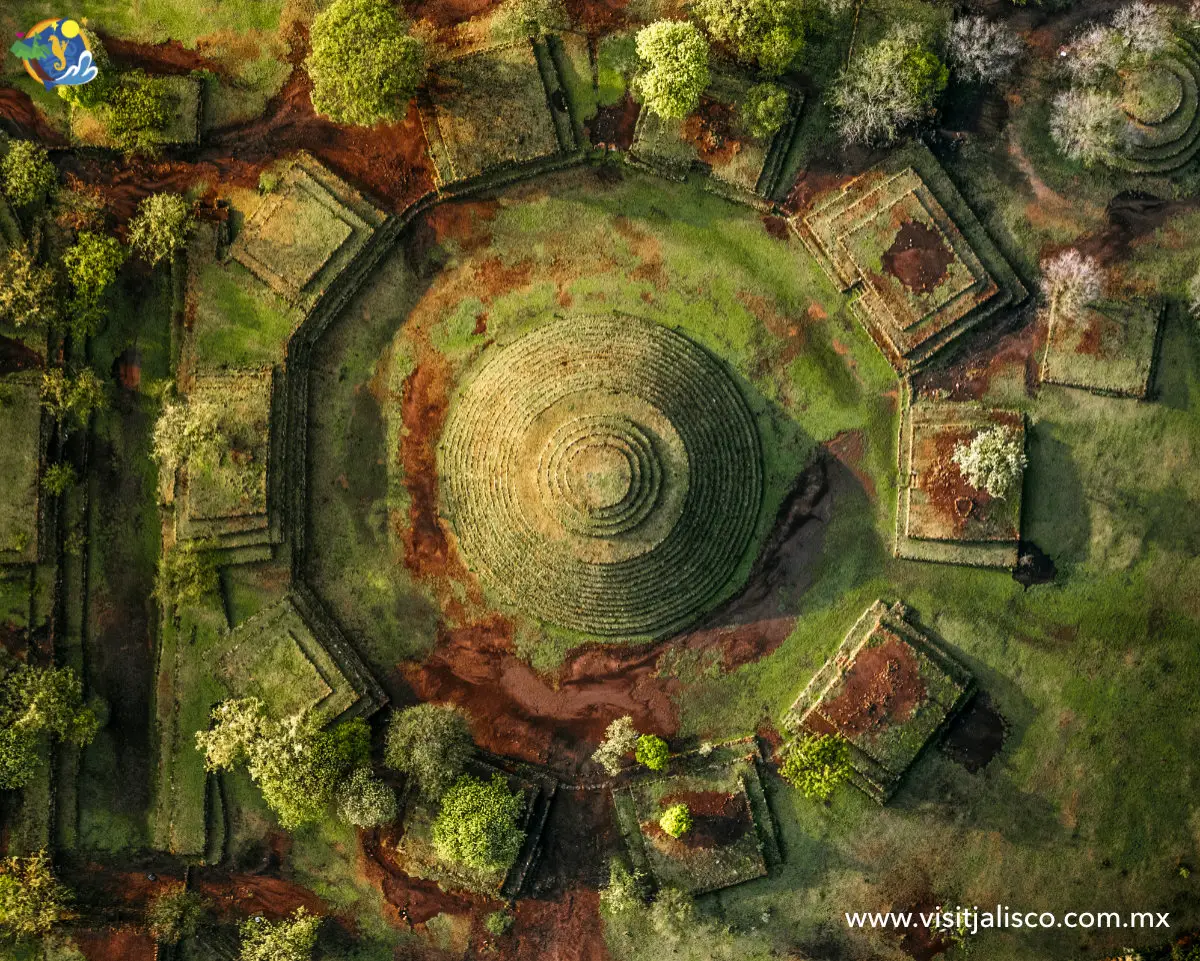
Guachimontones pyramids in Teuchitlan, Jalisco
Mathis Lídice (Félix Fernando Baños López)
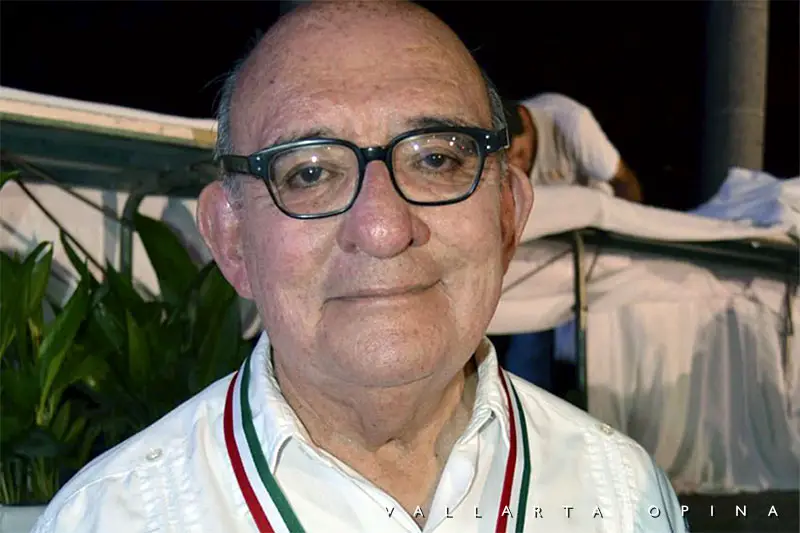
Mathis Lídice (Félix Fernando Baños López)
He worked two years on The Millennia sculpture requested by the local PV government to celebrate the new millennium.
Born on November 3, 1936 in Santiago Pinotepa Nacional, Oaxaca, Mexico.
Has lived in Puerto Vallarta since March 26, 1972.
His very active cultural and intellectual life has resulted in a long list of achievements, among these, we can mention some of the ones related directly to the artistic life and culture in Puerto Vallarta.
- Promoted the statue “Nostalgia” by sculptor and artist Ramiz Barquet and its placement on the Malecon in 1984.
- As part of the Sister Cities committee, participated in the project that concluded with the placement of “The Friendship Fountain” on the Malecon in 1987.
- Worked on the project to install sculptures as the visual finishing touch for all the Malecon’s perpendicular streets. Reinstalled the original Seahorse Statue (The Boy on the Seahorse) at Las Pilitas Beach, restored by Fernando Baños, Rafael Zamarripa and financed by Alejandro Meza.
- Authored the lyrics for the official Puerto Vallarta hymn, approved by the local government in May 1987.
- Future works include a sculpture in honor of Guadalupe Sánchez Torres, founder of Puerto Vallarta, and a monumental bust of the city historian Carlos Munguía Fregoso.
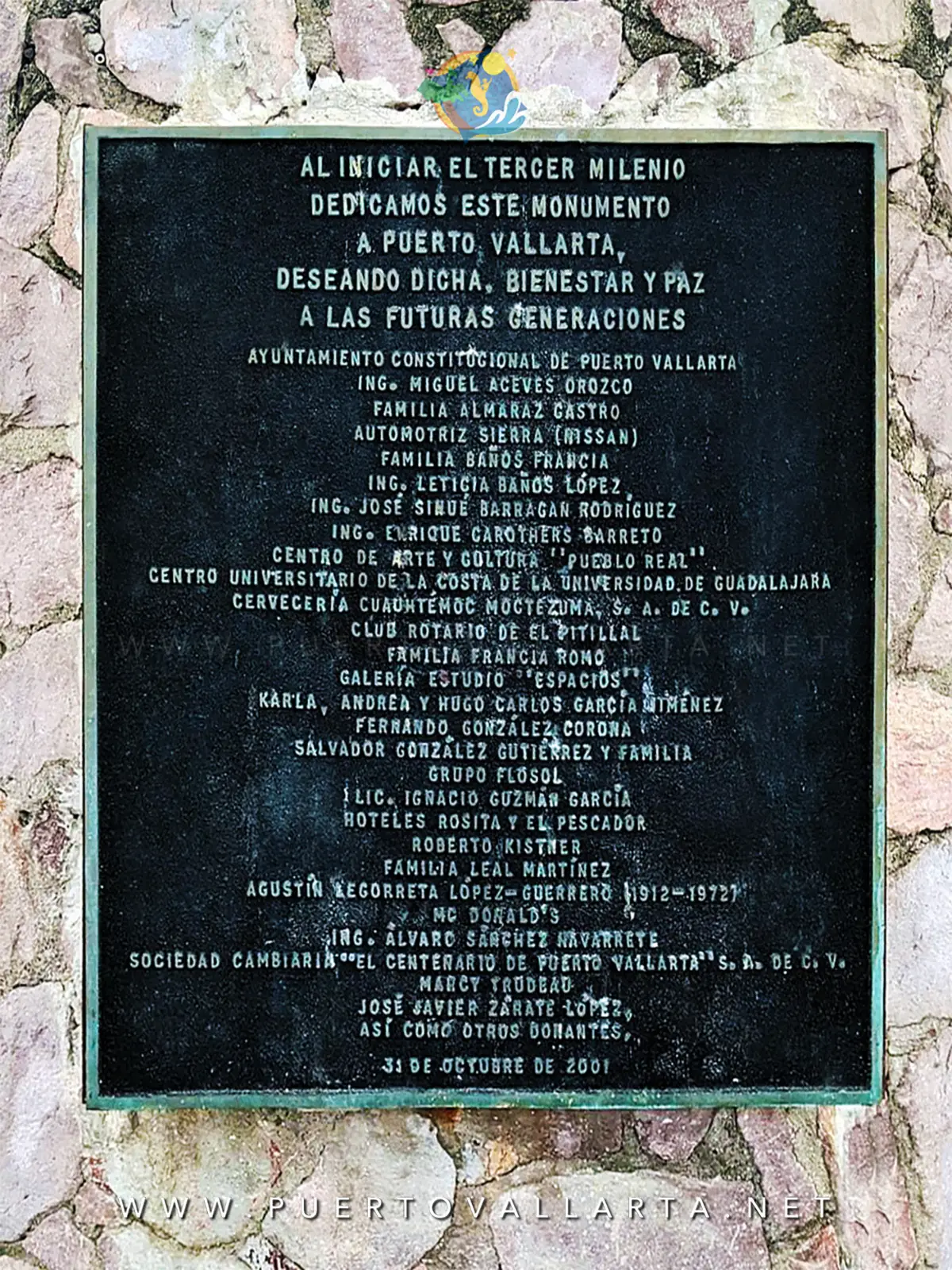
Los Milenios (The Millennia) plaque
FAQ
- What is the safest part of Puerto Vallarta to stay in?
The Marina and the Romantic Zone are considered some of the safest areas to stay in Puerto Vallarta. Both areas are popular among tourists and offer a variety of accommodations, restaurants, and attractions. The Marina is known for its upscale atmosphere, luxury resorts, and high-end shops and restaurants. It has a very secure, controlled environment with 24/7 security personnel. The Romantic Zone offers a more authentic Mexican experience with cobblestone streets, colorful colonial buildings, and a vibrant mix of galleries, cafes, and bars. As a central tourist area, it also has a strong police presence and is considered very safe.
- Where do locals go in Puerto Vallarta?
Locals in Puerto Vallarta enjoy spending time at the city’s beautiful beaches, scenic parks, and lively local markets. Popular beach spots include Playa de Oro, Playa Las Animas, and Playa Camarones for their soft sand and calm waters. Many locals visit the Vallarta Botanical Gardens to enjoy the lush vegetation and hiking trails. They also frequent authentic local food venues like Birrieria las 3 Regiones taco stand, cafes like Cafecito Vallarta, and neighborhood bars like La Cerveceria Union. The downtown Lazaro Cardenas market is a favorite for produce, spices, crafts.
- Is Downtown Puerto Vallarta nice?
Yes, downtown Puerto Vallarta is an exceptionally nice and popular area, celebrated for its vibrant mix of historic Mexican charm and a lively beach town atmosphere. It features a picturesque historic center with cobblestone streets, colorful buildings, and the iconic Parish of Our Lady of Guadalupe church. The downtown seamlessly blends into the scenic Malecón, a beautiful oceanfront boardwalk lined with fascinating sculptures, shops, and restaurants, making it perfect for strolling and enjoying the stunning ocean views.
The area offers an excellent variety of dining, from upscale restaurants to authentic street food, along with fantastic shopping in boutiques and art galleries. Adjacent to the main center is the popular Zona Romántica (Romantic Zone), known for its trendy vibe and energetic nightlife. The entire downtown is considered safe and is very walkable, allowing visitors to easily explore its captivating blend of culture, cuisine, and coastal beauty on foot.
Tip: For an unforgettable experience, head down to the Malecón or any beachfront spot about 30 minutes before the scheduled sundown to watch the spectacular sunset over the bay.
- What is considered old town in Puerto Vallarta?
Old Town, also known as the Romantic Zone or Zona Romántica, is considered the historic heart of Puerto Vallarta. It is characterized by its picturesque cobblestone streets, classic whitewashed buildings, red-tiled roofs, and a lively mix of shops, galleries, restaurants and bars. Nestled between the Sierra Madre mountains and Banderas Bay, Old Town has a traditional Mexican village charm with its colonial architecture and slower pace compared to the rest of Puerto Vallarta. Its romantic ambience comes from the area’s natural beauty, outdoor cafes, and charming boutique hotels. Old Town offers visitors a taste of an authentic Mexican neighborhood.

Book tours & support us
- Best prices
- 100% Local Support
- 2 decades+ of experience in Puerto Vallarta

Puerto Vallarta news, tips & content
- New info every two weeks
- Free content, news, videos
- Unsubscribe at any time

Contact us via WhatsApp
- Talk with our reservations expert
- Real local and human support
- Book tours, hotels, transfers, and more.
Share this article, choose your favorite option!


