Summary
- The sun god, Huitzilopochtli, was the most powerful and revered deity in the Aztec pantheon, and the patron of the warriors and the rulers.
- The Aztecs believed that the sun god was born from the earth goddess, Coatlicue, and that he had to fight his sister, the moon goddess, Coyolxauhqui, and her 400 brothers, the stars.
- The sun god needed human blood to sustain his strength and movement across the sky, and that the Aztecs performed ritual sacrifices to feed him.
- The sun god was associated with the hummingbird, the eagle, the fire, and the color blue.
- The sun god had a temple on top of the Great Pyramid of Tenochtitlan, the capital of the Aztec empire, where his statue and his sacred bundle were kept.
- The sun god still lives in the memory and the culture of the Mexican people, and that his symbolism and influence can be seen in many aspects of their art, literature, and identity.


Introduction
For many centuries before the arrival of the Spaniards, the indigenous people who lived in Mexican territory had shown a profound devotion and respect for the sun: the most powerful star of the cosmos had a notable influence on the social organization of the people of the time.
One of the most simple and earliest of the sun adoration rituals was, according to the experts, that of the primitive hunters, who offered it the first pieces of meat-torn from the animals that, with great effort, they had captured.
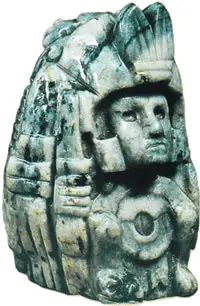
Later, with the development of agriculture and the subsequent unfolding of Mesoamerican civilizations, the sun’s warmth and its veneration became intertwined with the cult of rain and water.
The earth, hostile during the dry season, became fertile and prodigious with rain and sun. That is why great ceremonies were organized on the equinoxes: to celebrate these changes in the universe.
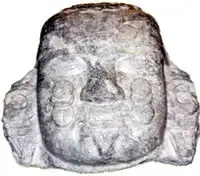
Towards the end of the Classical Period (between the years 900 and 1200 D.C.), the sun cults acquired a more specific expression. Researchers believe that its development corresponds to the increasing predominance of the warriors in these societies. That is why the solar ceremonies and rituals acquired an increasingly militaristic character, related to the conquests and the expanding of the warrior states that little by little came to dominate all the Mesoamerican territory.
THE SUN’S TRANSIT
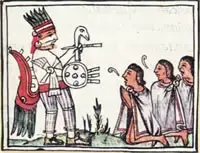
For the Mexicas or Aztecs, whose civilization flourished between the XIV and XVI centuries in the Mexican Central Plateau, the universe was a living entity, in movement, whose center was the Sun, source of the vital energy symbolized by light, warmth, blood. To ensure the survival of the cosmos, the Sun had to be kept alive and in continuous motion in the sky. War became the means by which the divine sustenance was obtained: the blood and hearts of the enemies captured in combat were transformed into a source of life.
The daily movement of the Sun, called Tonatiuh in náhuatl or Aztec language, had four discernible stages. It arose at dawn in the east and was then venerated as a beautiful child by the name of Piltzintecuhtli or Yellowface. During its journey through the sky, from the early hours of the morning until its full expression at midday, it was associated with Xiutecuhtli, “Lord of Turquoise”, since during these hours its light allowed the sky to acquire a beautiful blue hue, similar to the semiprecious stone.
In the early afternoon, the Sun began its descent, in a journey that took it towards the west to the Land of Women, Cihuatlampa, where after fighting against the nocturnal specters and its astral enemies it sunk into a hole. Abundant blood was lost by the star during this battle that dyed the sunset an intense red. Then it was also represented as a descending eagle, from whence the meaning of the name Cuauhtémoc, “eagle that falls”. comes.
When nighttime came the Sun began its journey inside the earth, and as though it were a reflection in an obsidian mirror it acquired a black color that contrasted with the red and yellow of the day. It was a time of preparation for its rebirth the following morning with the first beam of solar light.
THE TRIUMPHANT SUN
The king of stars, the great warrior, was incarnated according to the Aztecs in Huitzilopochtli, one of the four deities of creation, and their tutor god. It was Huitzilopochtli who guided these people on their long pilgrimage from the mythical Aztlán to Mexico-Tenochtitlan. the Promised Land where their empire’s capital was established.
Huitzilpochtli was the triumphant sun of the astral war. He demonstrated his great power when he vanquished his sister and enemy Coyolxauhqui, the Moon Warrior, whom he decapitated and tore apart, and forced his sisters The Stars, or Centzon Huiznahua (the Countless from the North) to flee. This allowed daylight, whose luminosity heralds the sun’s rays. to finally send its radiant color to the earth’s surface, announcing the daily birth of the star.
This solar power was demonstrated each month with the waning of the moon, and from time to time, with the lunar eclipses. These extraordinary events proved the fulfillment of the mythological tale of Huitzilopochtli’s birth.
SOLAR ART
During the Post Classical Period -from 1200 D.C. until the arrival of the Spaniards in the sixteenth century-, all the Mesoamerican tribes. and especially the great empires had magnificent pyramids dedicated to the solar cult in the center of their cities. There they performed human sacrifices in which the victim’s heart was extracted to symbolically nourish the solar gods and to propitiate the earth’s fertility and the continuity of life. These rites coincided with the development of the conquering expeditions and generally took place in the dry season, in order to obtain a good harvest.
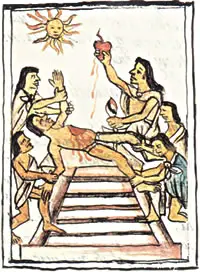
Archaeologists have studied different representations where symbols and images of the deities can be appreciated, as well as diverse altars to the sun and to the sacrificial rituals. Among the earliest and, therefore, most interesting, are those from the southern region of Guatemala, considered contemporaries of the Mayan world, specifically those of Santa Lucía Cotzumaluapa. A stellae that today is in the Berlin Ethnographic Museum, in Germany, shows the deity represented as a high ranking individual who emerges from the radiant disk and receives the offering bestowed by warriors and ballplayers.
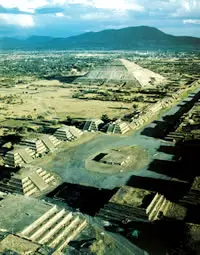
Reliefs that symbolize fire, as well as an impressive disk, unfortunately, fragmented, with a human skull showing its tongue and surrounded by a pleated paper decoration, were found in the sacred city of Teotihuacán during the explorations made on the front facade of the Pyramid of the Sun. This element has been called the Disk of the Dead Sun, since it is associated with the fact that the entrance, or facade, of this pyramid and its temple, are facing west, the direction of the region where the sun dies and begins its nocturnal journey through the Earth’s interior.
The most extraordinary representations of the solar element belong to the Aztec culture. This is not surprising for people who exalted Huitzilopochtli as their principal deity, and therefore created magnificent images of the sun’s power. The most comprehensive example of the above is the Sun Stone, known as the Aztec Calendar, which is acknowledged to be an unfinished monument whose final destiny would have been as a platform for gladiatorial sacrifice.

It would have formed a cylinder whose upper portion would have had a sculpted image of the solar disk and, on the side, the military conquests of these people. just as can be seen in the Tizoc Stone and in the Cuauhxicalli of the emperor Moctezuma Ilhuicamina, known as the Ex-Arzobispado Stone.
In these three monuments, we find repeated the image of the solar disk made up of four rays that look like the letter “A”, with the ends of the sacred prongs used for sacrifice and auto-sacrifice appearing in the spaces between the lines. Thus the Sun is transformed into a divine zacatapoyolli, which looks like a deified ball of hay, with prongs threaded in for obtaining blood. This way the four rays would alternate on the disk with the four-prong ends. decorated with feathers from an eagle -the sunbird- and precious jade stones or chalchihuites.
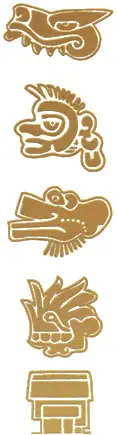
In its inner circles, the Sun Stone also has a band with the twenty signs of the indigenous calendar. Together with the symbol ollin or movement -made up of four small squares with the four suns that came before the fifth creation, which is the present era- it depicts in a solemn visual image the sun’s participation in the creation of the universe. According to the legend, the cosmos came to be and was destroyed four times before the time of the Aztecs, and of course, the daily movement of the Sun systematically produced the passing of time. It was then the mission of men to create a counting system, which was assuredly accomplished in the fantastic Mesoamerican calendars.

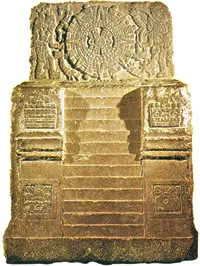
The Teocalli of the Sacred War, which in its time formed part of the design, function, and decoration of the Aztec emperor Moctezuma Xocoyotzin’s Palace, has as the main element of its facade -since it is a portrayal of an idealized model of an indigenous temple- the solar god, with a depiction of ollin, movement, at its center. On its left and right sides -from our perspective as spectators- the figure of Huitzilopochtli is present, one of the few preserved images of this tutor deity. There he appears as a prominent warrior, a young man with a fierce face, dressed in his hummingbird disguise, with the sacrificial prongs in his hand and in the place of one of his feet the head of Xiuhcóatl, the Fire Serpent, which in addition to being his weapon, was also in charge of leading the sun king through the sky.
Although there are no monumental sculptures of either Tonatiuh or Huitzilopochtli -since it is known that the figure of the deity that presided the main temple in Mexico-Tenochtitlan was made annually with amaranth seeds held together with human blood and honey-, in the Ethnographic Museum in Basil, Switzerland, there is a beautiful image in a small format that depicts the Sun God seated on his throne and carrying on his back an ostentatious circular feather ornament, which also has a representation of ollin in the center.
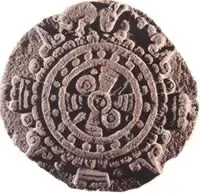
The warriors in charge of capturing the prisoners who would be offered to the solar deity were disguised as eagles, also a representation of the Sun God and they were the heroes and idols of the youngsters. Until the end of their civilization, all the inhabitants of Mexico-Tenochtitlan felt an incommensurate pride and enormous will to give themselves up to the service of Huitzilopochtli, the triumphant Sun.
It was he who gave them life; he was the main reason for their existence. Offering their life so that, with the spilled blood, the spectre of darkness would be cast away and the Sun’s power would be confirmed: there was no greater mission, there was no better destiny for a true man.
Author: Felipe Solís Olguín, (18 December 1944 – 23 April 2009) was an expert in History and Archaeology, Director of the National Museum of Anthropology and History.
FAQ
- What is the safest part of Puerto Vallarta to stay in?
The Marina and the Romantic Zone are considered some of the safest areas to stay in Puerto Vallarta. Both areas are popular among tourists and offer a variety of accommodations, restaurants, and attractions. The Marina is known for its upscale atmosphere, luxury resorts, and high-end shops and restaurants. It has a very secure, controlled environment with 24/7 security personnel. The Romantic Zone offers a more authentic Mexican experience with cobblestone streets, colorful colonial buildings, and a vibrant mix of galleries, cafes, and bars. As a central tourist area, it also has a strong police presence and is considered very safe.
- Where do locals go in Puerto Vallarta?
Locals in Puerto Vallarta enjoy spending time at the city’s beautiful beaches, scenic parks, and lively local markets. Popular beach spots include Playa de Oro, Playa Las Animas, and Playa Camarones for their soft sand and calm waters. Many locals visit the Vallarta Botanical Gardens to enjoy the lush vegetation and hiking trails. They also frequent authentic local food venues like Birrieria las 3 Regiones taco stand, cafes like Cafecito Vallarta, and neighborhood bars like La Cerveceria Union. The downtown Lazaro Cardenas market is a favorite for produce, spices, crafts.
- Is Downtown Puerto Vallarta nice?
Yes, downtown Puerto Vallarta is an exceptionally nice and popular area, celebrated for its vibrant mix of historic Mexican charm and a lively beach town atmosphere. It features a picturesque historic center with cobblestone streets, colorful buildings, and the iconic Parish of Our Lady of Guadalupe church. The downtown seamlessly blends into the scenic Malecón, a beautiful oceanfront boardwalk lined with fascinating sculptures, shops, and restaurants, making it perfect for strolling and enjoying the stunning ocean views.
The area offers an excellent variety of dining, from upscale restaurants to authentic street food, along with fantastic shopping in boutiques and art galleries. Adjacent to the main center is the popular Zona Romántica (Romantic Zone), known for its trendy vibe and energetic nightlife. The entire downtown is considered safe and is very walkable, allowing visitors to easily explore its captivating blend of culture, cuisine, and coastal beauty on foot.
Tip: For an unforgettable experience, head down to the Malecón or any beachfront spot about 30 minutes before the scheduled sundown to watch the spectacular sunset over the bay.
- What is considered old town in Puerto Vallarta?
Old Town, also known as the Romantic Zone or Zona Romántica, is considered the historic heart of Puerto Vallarta. It is characterized by its picturesque cobblestone streets, classic whitewashed buildings, red-tiled roofs, and a lively mix of shops, galleries, restaurants and bars. Nestled between the Sierra Madre mountains and Banderas Bay, Old Town has a traditional Mexican village charm with its colonial architecture and slower pace compared to the rest of Puerto Vallarta. Its romantic ambience comes from the area’s natural beauty, outdoor cafes, and charming boutique hotels. Old Town offers visitors a taste of an authentic Mexican neighborhood.

Book tours & support us
- Best prices
- 100% Local Support
- 2 decades+ of experience in Puerto Vallarta

Puerto Vallarta news, tips & content
- New info every two weeks
- Free content, news, videos
- Unsubscribe at any time

Contact us via WhatsApp
- Talk with our reservations expert
- Real local and human support
- Book tours, hotels, transfers, and more.
Last updated on:
Share this article, choose your favorite option!