Summary
- The temascal is a type of steam bath that was used by the indigenous people of Mexico for health and spiritual purposes.
- The temascal is a dome-shaped structure made of stone, mud, or wood, with a small entrance and a fire pit inside.
- It is heated by placing hot stones in the fire pit, and then pouring water and herbs over them to create steam.
- The temascal is led by a guide or a healer, who chants, prays, and plays musical instruments during the sessions, and helps the participants to relax, purify, and renew their bodies and minds.
- It has many benefits, such as detoxifying the skin, improving the circulation, relieving the stress, strengthening the immune system, balancing the hormones, and enhancing the mood.
- The temascal is also a ritual that connects the participants with the cosmos, the ancestors, and the divine forces.


Introduction
One of the reasons that the ancient nomads from Northern Mexico began to settle in the central plateau, becoming one of the most important human contributions to Aztec civilization was undoubtedly the lure of the volcanoes.
The fertile surrounding land, and furthermore the innumerable hot water springs that surface all along the neo-volcanic mountain range, all of which today continue being one of the greatest attractions of the central part of the Mexican territory.
The new inhabitants of this shaky land, knew from the very beginning how to take advantage of and enjoy the fusion of fire and water not only to purify but to heal or simply relax their bodies, turning these elements into two of their well-known gods.
It is enough to imagine the sensations of the Prehistoric man when he, just like modern day man, first entered one of these magical caves (like those of Tolantongo, an oasis in the middle of the arid Mezquital Valley in the state of Hidalgo. Traversing its waterfall are natural hot water baths where one can comfortably sit down and enjoy a relaxing steam bath), without a doubt an indelible experience for any person from any epoch and place.
From then on, would human beings not try to somehow copy these divine caverns in their own land, within their own homes? This is how the temascal (also temazcal or temaxcal) was born: a very small structure, sometimes half buried, with a rectangular, square or round roof, almost always vaulted, and a tiny entrance, tiny so it is easy to close and through which, like in a cave, one has to stoop to enter or even crawl in, and which usually barely fits two people: husband and wife, patient and healer, midwife and pregnant wife.
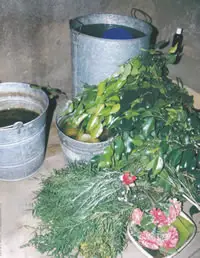
Temascal, the Mexican equivalent of a sauna and more
In a straight angle from the entrance, there is a little stone oven, attached to the structure, which is fueled with wood and allowed to burn until it becomes hot coals. This is the temascal’s soul, the xitle or navel, the place of the fire god himself. Inside, large porous rocks, or just plain tepalcates, burn by the god’s force.
The bathers who have just entered the darkness of the inner space, guided only by the light of a tiny opening, have closed the small entrance and feel as though they are in the oven’s womb.
Before sitting or lying on the ground, they begin to sprinkle the stones with a medicinal herb infusion, and immediately hot steam, resulting from the union of water and fire, invades the tiny space, filling the bodies with a deep sense of relaxation.
Then begins the greatest benefit of the temascal bath: the healer, using an hojeador, that is to say a handful of leaves or twigs from the Pirul tree or some other medicinal plant, fans the bather, thus bringing the concentrated steam from the highest part of the temascal to the body that is to be healed, part by part, or toward an unhealthy organ, a broken bone, a twisted joint, a womb about to give birth, some congested lungs, muscle spasms or some other health issue.
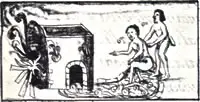
For the Otomf people, it is not only a matter of bathing, of cleansing, but of “cleaning both body and soul”, since the elimination of bodily impurities goes hand in hand with the revitalization of the breath, that fragile representation of the human soul.In some communities, such as the Otomf or Nahnif in central Mexico, the temascal is large and can harbor a whole family, whose members thus take the bath together. As night falls, the fire irradiates its light and warmth from the inside of the temascal, and when the steam invades the enclosure everyone softly strikes themselves with twigs, amidst laughter and mischievous games.
“When I come out of the temascal, my body has been refreshed and I can see the light”, says an old Otomi man.
TEMASCAL, LIKE RETURNING TO THE WOMB

Temascales come in all shapes and forms
In the indigenous universe both in central and southern Mexico (even the Tojolobales in Chiapas are familiar with a temascal made out of planks), the temascal is of fundamental importance: it is part of a sensual experience of the world and of fertility. And as the opposite of the indigenous kitchen’s hearth, which is the home’s masculine pole, the temascal is the feminine pole par excellence. It is the maternal womb where people are born, and where the sick return to be healed and reborn.
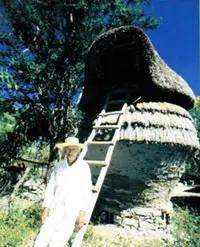
Another Temascal style
More so perhaps than the kitchen. the temascal is the woman’s place, the most intimate place of her being. One of the temascal’s fundamental functions in the indigenous world has been and in fact still is, although less so every day, to help the pregnant woman during the rituals of birth and purification. This is the place where she is tended by the midwife during the long months of her pregnancy, where the future child is touched and rubbed in order to straighten it out if it is poorly positioned; where it is received by the mid-wife, who squats in front of the mother’s stomach amidst the steam saturated with aromas that will help a difficult birth; where the new born baby is bathed in small tubs with rose petals floating on the warm water; where the mother’s painful abdomen is fanned during repeated baths after the child is bom. Thus, like the cave itself, the temascal’s archetype (with its vaulted form, round like a pot) is the warm, moist womb from whence we all come and where we all want to return to save ourselves -in this case, cure ourselves-, in the benevolent maternal womb, in the bowels of the Earth itself.

This fundamental concept and function of the temascal were already present in Pre Hispanic times. We listen to the advice given many centuries ago by an old man to a couple’s parents, recorded by a chronicler during the Conquest:
“Sir and madam, this young girl is now in the days of child birthing, and is weary with her pregnancy, because the time is arriving in which god’s will shall manifest itself. How do we know she will not die? It will be good for her to receive some baths, that she enters our mother the bath oven, which is called Yohualticitl, who is the goddess of the baths, knower of secrets, in whose hands all of us have been raised.”
And who was Yohualticitl if not the very same Toci, “our grandmother”, the mother creator of the gods: here referred to as Yohualticitl or “night doctor”, but also as Temazcalteci, “the grandmother of the baths”, patron of midwives and births, goddess of fertility, and also Tlazolteotl, goddess of the Earth, of fertility and of sexuality. That’s how the temascal as we know it today in the indigenous home has actually existed for millennia, at least in central Mexico.
As there were domestic altars that were small versions of the great altars and temples of the ceremonial centers in Pre-Hispanic antiquity, in the case of the temascal there were likewise those destined to the great rites, to the collective rites of Mesoamerican society. However, there are vestiges of great steam bath constructions. There are those of Xochicalco and Chichén Itza, places in which the temascal was built beside the ball game. It would seem natural that besides a place dedicated to sporting activities there be a place for cleansing after a game, as in the Greek buildings in Olympus, or the thermal baths constructed beside the gymnasium in Roman society.

Another Temascal style
But considering the sacred character of the Mesoamerican Aztec ball game, it is probable that the players, true priests of this rite, had to take a bath before entering the ball court to purify both body and soul, loosen the body’s muscles like a woman before giving birth, and also like her, relieve tension before such an important event, whose conclusion could be life or death.
The Xochicalco Temazcal is particularly ostentatious. Both its dimensions and location are noteworthy. And here we should remember that in ancient times the temazcalli, “house of baths” in Aztec, was also metaphorically called xochicalli. “house of flowers”. In Aztec poetry, we find that Tamoanchan -paradise, the mythical place of origin- was metaphorically referred to as Xochicalli or Xochicalco. It is not surprising if we consider that the temascal symbolically represented the longed for place of our birth, that it was referred to with the beautiful periphrasis of “house of flowers” or, on occasions, of “Our Lord’s meadow”.
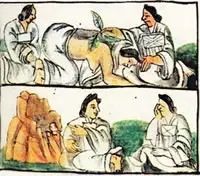
Temascal, a tradition with centuries of history
Could this be the reason that every June 24th, Day of San Juan, in the Puebla and Tlaxcala valley area it is customary to decorate the temascal baths with a flower rosary, a perfuming pot and a cross made of rose petals to -so it is said- protect the temascal throughout the year from the devil, the amocuale? Though not very sure about the answer, old folks from the region tell the story of a very beautiful girl whose mother took excessive care of her, locking her up every time she left the house. One day an old man knocked on the door; the young girl opened it and after speaking with him, the old man gave her a cup of water and told her that if she drank it all her dreams would come true. The trusting girl obeyed; shortly after she felt her body change and after some months a beautiful child was born. The mother, furious, took the child and threw him into a lake. A fisherman found him when pulling his net out of the water, and happily took him home to his wife, as they had no children. Thus, while the boy grew up happily with his adoptive parents. in the other house, mother and grandmother were transformed into Li temazcal bath. From the old woman came the poker, so she would always feel the martyrdom of the coals, where¬as the girl turned into the temascal’s world or globe, to give warmth to everyone who so desired since she had denied it to her own son by accepting her mother’s ignoble act.
Water and fire, warmth and love, water and soul: the temascal has been and continues to be. in our epoch of rediscovery of tradition’s spiritual value, a place and a practice in which human beings enter into a relationship with the cosmos, saving them.
FAQ
- What is the safest part of Puerto Vallarta to stay in?
The Marina and the Romantic Zone are considered some of the safest areas to stay in Puerto Vallarta. Both areas are popular among tourists and offer a variety of accommodations, restaurants, and attractions. The Marina is known for its upscale atmosphere, luxury resorts, and high-end shops and restaurants. It has a very secure, controlled environment with 24/7 security personnel. The Romantic Zone offers a more authentic Mexican experience with cobblestone streets, colorful colonial buildings, and a vibrant mix of galleries, cafes, and bars. As a central tourist area, it also has a strong police presence and is considered very safe.
- Where do locals go in Puerto Vallarta?
Locals in Puerto Vallarta enjoy spending time at the city’s beautiful beaches, scenic parks, and lively local markets. Popular beach spots include Playa de Oro, Playa Las Animas, and Playa Camarones for their soft sand and calm waters. Many locals visit the Vallarta Botanical Gardens to enjoy the lush vegetation and hiking trails. They also frequent authentic local food venues like Birrieria las 3 Regiones taco stand, cafes like Cafecito Vallarta, and neighborhood bars like La Cerveceria Union. The downtown Lazaro Cardenas market is a favorite for produce, spices, crafts.
- Is Downtown Puerto Vallarta nice?
Yes, downtown Puerto Vallarta is an exceptionally nice and popular area, celebrated for its vibrant mix of historic Mexican charm and a lively beach town atmosphere. It features a picturesque historic center with cobblestone streets, colorful buildings, and the iconic Parish of Our Lady of Guadalupe church. The downtown seamlessly blends into the scenic Malecón, a beautiful oceanfront boardwalk lined with fascinating sculptures, shops, and restaurants, making it perfect for strolling and enjoying the stunning ocean views.
The area offers an excellent variety of dining, from upscale restaurants to authentic street food, along with fantastic shopping in boutiques and art galleries. Adjacent to the main center is the popular Zona Romántica (Romantic Zone), known for its trendy vibe and energetic nightlife. The entire downtown is considered safe and is very walkable, allowing visitors to easily explore its captivating blend of culture, cuisine, and coastal beauty on foot.
Tip: For an unforgettable experience, head down to the Malecón or any beachfront spot about 30 minutes before the scheduled sundown to watch the spectacular sunset over the bay.
- What is considered old town in Puerto Vallarta?
Old Town, also known as the Romantic Zone or Zona Romántica, is considered the historic heart of Puerto Vallarta. It is characterized by its picturesque cobblestone streets, classic whitewashed buildings, red-tiled roofs, and a lively mix of shops, galleries, restaurants and bars. Nestled between the Sierra Madre mountains and Banderas Bay, Old Town has a traditional Mexican village charm with its colonial architecture and slower pace compared to the rest of Puerto Vallarta. Its romantic ambience comes from the area’s natural beauty, outdoor cafes, and charming boutique hotels. Old Town offers visitors a taste of an authentic Mexican neighborhood.

Book tours & support us
- Best prices
- 100% Local Support
- 2 decades+ of experience in Puerto Vallarta

Puerto Vallarta news, tips & content
- New info every two weeks
- Free content, news, videos
- Unsubscribe at any time

Contact us via WhatsApp
- Talk with our reservations expert
- Real local and human support
- Book tours, hotels, transfers, and more.
Last updated on:
Share this article, choose your favorite option!