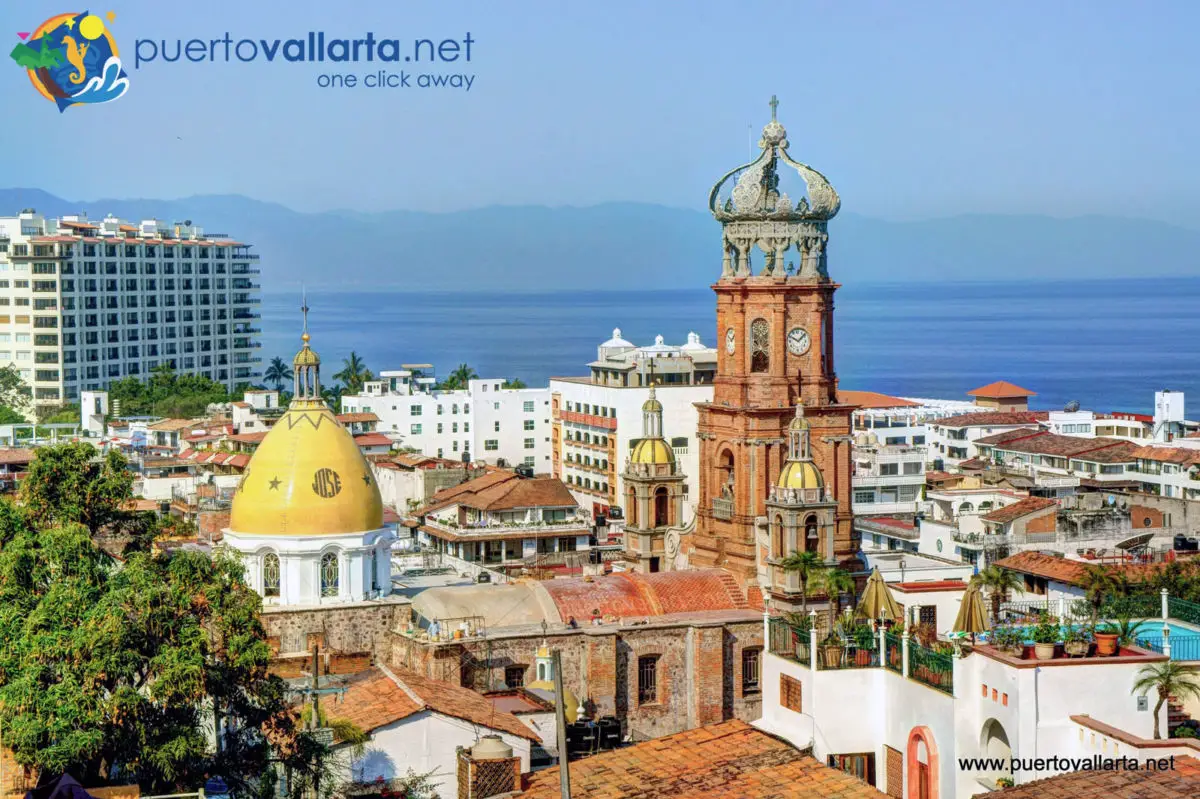
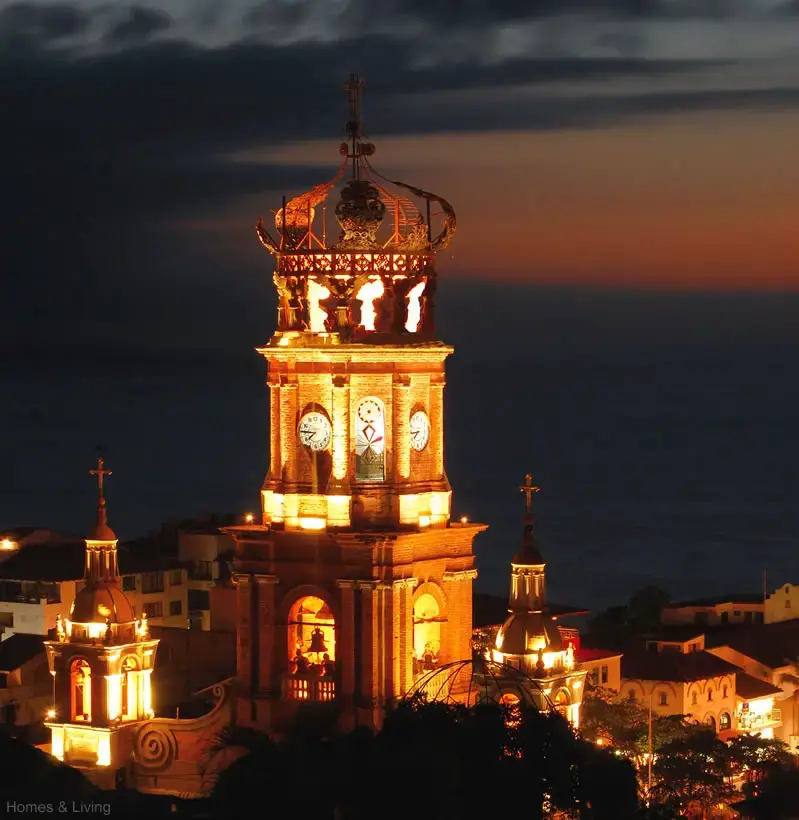
Who can forget a delicious day of adventure or relaxation on the beaches of Puerto Vallarta? Who could not enjoy and appreciate the beautifully varied and colorful sunsets that every evening paint the hills and buildings of the harbor with a different color palette?
Read our main article on:
Our Lady of Guadalupe Parish/Church.
Everything is so wonderful in the mind of spectator, they enjoy the scenery as the evening approaches, but a striking architectonic structure stands out among all the elements near the Malecon: a crown appears high up in the sky held up by a tower. This symbol represents the city and is used as an icon for the whole area, the crown and the Parish is located just a few blocks from the newly renovated seaside promenade, the Malecon. The locals also proudly call it the “Cathedral” of Puerto Vallarta.
The church itself really doesn’t have a well defined style; the crown is baroque and is purportedly a replica of the crown that Empress Carlota carried, consort of Maximilian of Habsburg, Emperor of Mexico in 1864, but it’s not the case, it was designed by the priest Don Rafael Parra Castillo, the same person that designed the church tower.
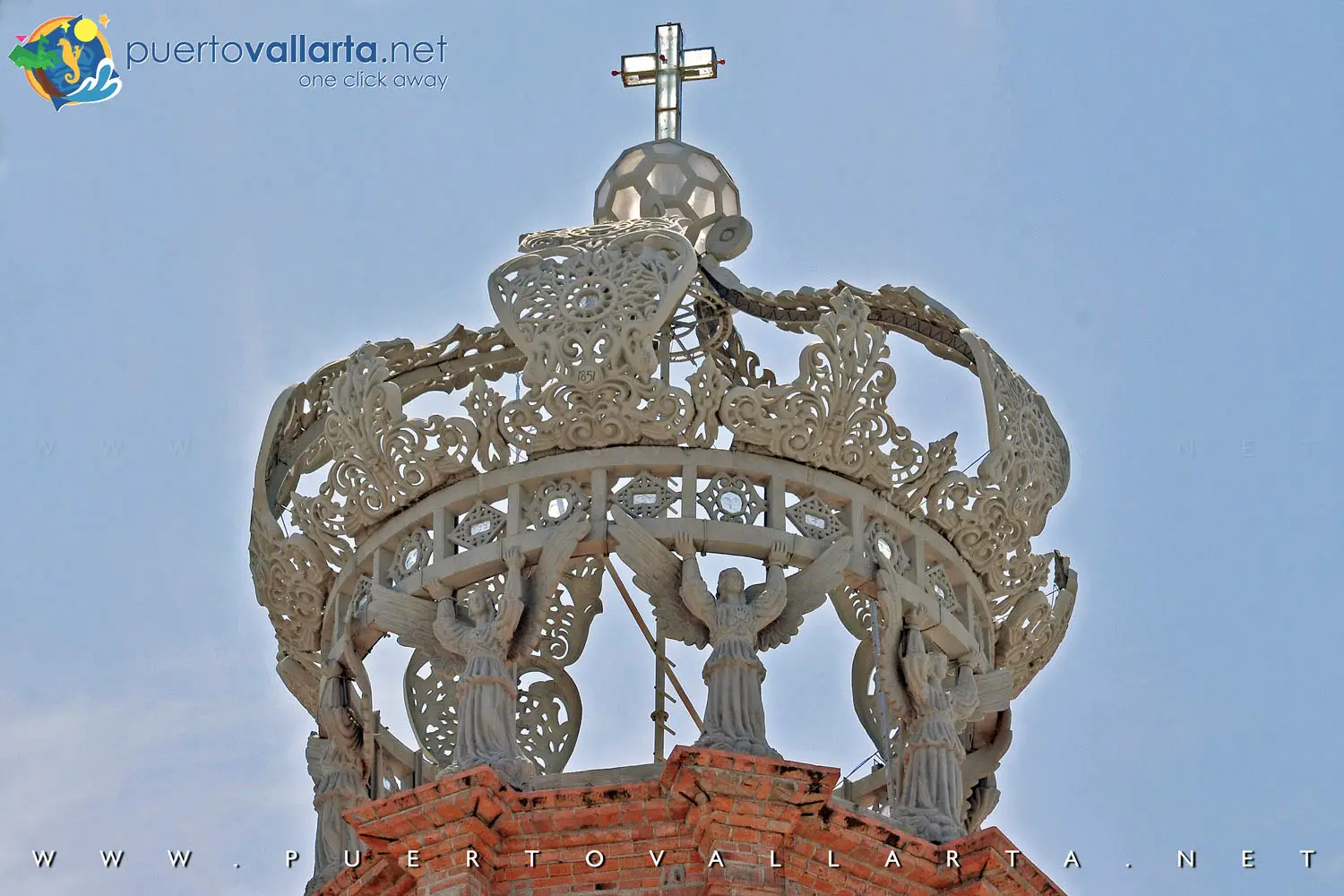
Crown on the tower of Our Lady of Guadalupe Parish, Puerto Vallarta by Rafael Parra Castillo, José Esteban Ramírez Guareño (1963), Carlos Terres (2009)
The Parish with its unusual combination of styles, ranging from Renaissance towers and the Neoclassical style of the main building, to the contemporary Mexican folk art details, in the end results in a mish-mash masterpiece resulting from the combination of diverse ideas and inspiration from everyone including the masons and bricklayers, priests and the people of Puerto Vallarta.
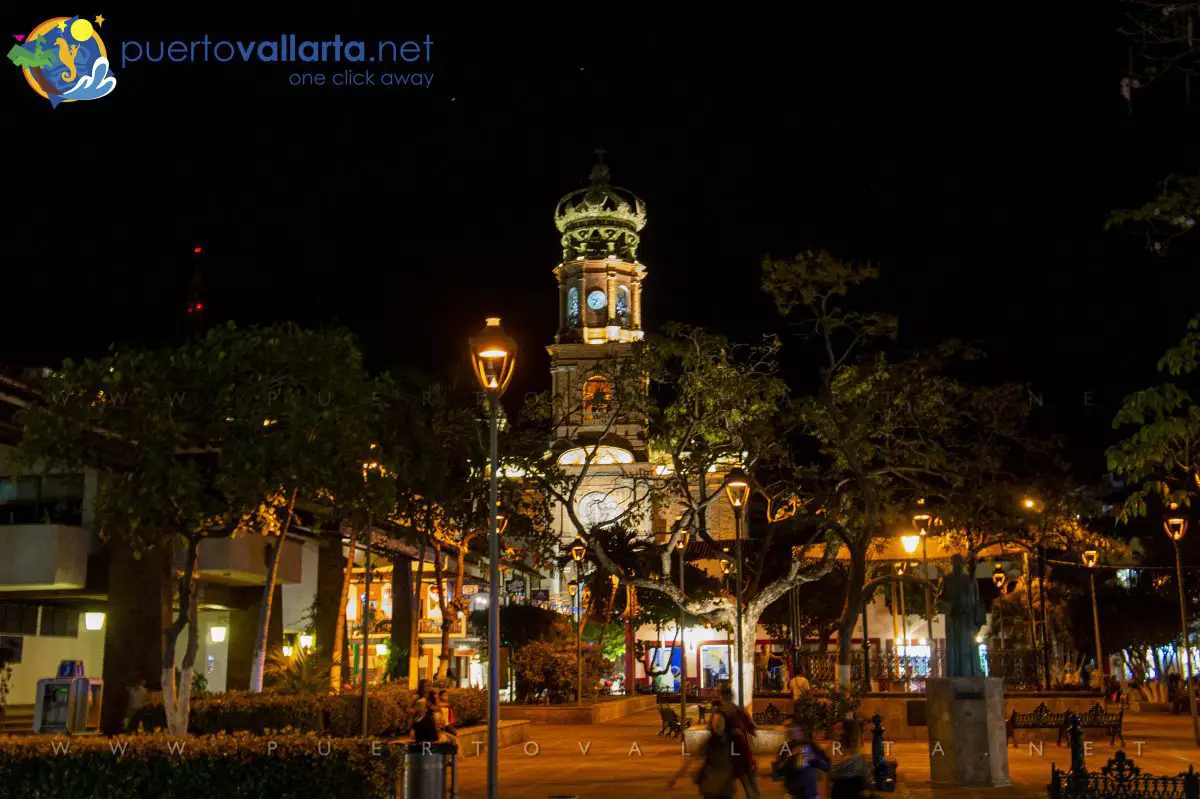
Our Lady of Guadalupe Cathedral and the Main Square in downtown Puerto Vallarta
The temple started off in the early XX Century, as the first church in Puerto Vallarta. The initial idea was that it was to be a small chapel in honor of Our Lady of Guadalupe, this was the general idea until Father Francisco Ayala, around 1915, suggested that the building should be a tribute to the original Guadalupe Church in Mexico City, the Basilica of Guadalupe. With this as the guideline the chapel soon became a parish.
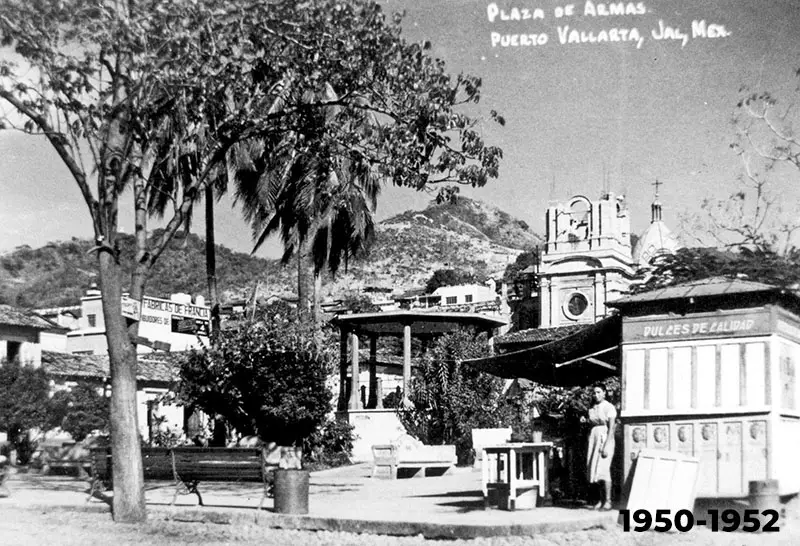
The main tower is still under construction in this photo (so the photo is pre-1955).
Like many other buildings in Mexico, construction was stopped during the Cristero War. The construction of an area for the chorus, complete with dome and upper body, was the starting signal for the next stage of the church’s development.
On the day of Virgin Guadalupe apparition’s 420th anniversary, according to records of the Catholic Church, the dome of the Parish was finally finished.
By 1952 the main tower was visible all over the city, but it was not until 1963 (1965 in the book by local historian Carlos Munguía Fregoso) that the crown, designed by Jose Esteban Ramirez Guareño, was placed on top of the tower. The cross and sphere on top of the crown are the work of another artist, Esteban Ávalos Haro. The external design of the towers was completed in 1987.
The temple is the heart of the Catholic faith of both residents and tourists, masses are conducted in Spanish, French and English, and a bilingual Mass is held on Saturdays and Sundays (more in our Church Section).
Bells tolling are a typical part of local city soundscape during the weekends, and are even more so during festivities honoring the Virgin of Guadalupe, during the first 12 days of the month of December.

Tastes, sounds, colors and the sea breeze in the air combine to captivate the senses of everyone who comes close.
Surely the church is now a symbol for this famous beach destination, a very Mexican Puerto Vallarta, that should not only be admired from the outside, but also from within.
In contrast to the religious images on painted wood, the marble altar, carved wooden confessionals and the image of the Virgin Guadalupe by Ignacio Ramirez, artist of our state of Jalisco, this building overflows with love, devotion and sacrifices, and must be added to your short list of places you absolutely must visit on your trip to Puerto Vallarta.
FAQ
- What is the safest part of Puerto Vallarta to stay in?
The Marina and the Romantic Zone are considered some of the safest areas to stay in Puerto Vallarta. Both areas are popular among tourists and offer a variety of accommodations, restaurants, and attractions. The Marina is known for its upscale atmosphere, luxury resorts, and high-end shops and restaurants. It has a very secure, controlled environment with 24/7 security personnel. The Romantic Zone offers a more authentic Mexican experience with cobblestone streets, colorful colonial buildings, and a vibrant mix of galleries, cafes, and bars. As a central tourist area, it also has a strong police presence and is considered very safe.
- Where do locals go in Puerto Vallarta?
Locals in Puerto Vallarta enjoy spending time at the city’s beautiful beaches, scenic parks, and lively local markets. Popular beach spots include Playa de Oro, Playa Las Animas, and Playa Camarones for their soft sand and calm waters. Many locals visit the Vallarta Botanical Gardens to enjoy the lush vegetation and hiking trails. They also frequent authentic local food venues like Birrieria las 3 Regiones taco stand, cafes like Cafecito Vallarta, and neighborhood bars like La Cerveceria Union. The downtown Lazaro Cardenas market is a favorite for produce, spices, crafts.
- Is Downtown Puerto Vallarta nice?
Yes, downtown Puerto Vallarta is an exceptionally nice and popular area, celebrated for its vibrant mix of historic Mexican charm and a lively beach town atmosphere. It features a picturesque historic center with cobblestone streets, colorful buildings, and the iconic Parish of Our Lady of Guadalupe church. The downtown seamlessly blends into the scenic Malecón, a beautiful oceanfront boardwalk lined with fascinating sculptures, shops, and restaurants, making it perfect for strolling and enjoying the stunning ocean views.
The area offers an excellent variety of dining, from upscale restaurants to authentic street food, along with fantastic shopping in boutiques and art galleries. Adjacent to the main center is the popular Zona Romántica (Romantic Zone), known for its trendy vibe and energetic nightlife. The entire downtown is considered safe and is very walkable, allowing visitors to easily explore its captivating blend of culture, cuisine, and coastal beauty on foot.
Tip: For an unforgettable experience, head down to the Malecón or any beachfront spot about 30 minutes before the scheduled sundown to watch the spectacular sunset over the bay.
- What is considered old town in Puerto Vallarta?
Old Town, also known as the Romantic Zone or Zona Romántica, is considered the historic heart of Puerto Vallarta. It is characterized by its picturesque cobblestone streets, classic whitewashed buildings, red-tiled roofs, and a lively mix of shops, galleries, restaurants and bars. Nestled between the Sierra Madre mountains and Banderas Bay, Old Town has a traditional Mexican village charm with its colonial architecture and slower pace compared to the rest of Puerto Vallarta. Its romantic ambience comes from the area’s natural beauty, outdoor cafes, and charming boutique hotels. Old Town offers visitors a taste of an authentic Mexican neighborhood.

Book tours & support us
- Best prices
- 100% Local Support
- 2 decades+ of experience in Puerto Vallarta

Puerto Vallarta news, tips & content
- New info every two weeks
- Free content, news, videos
- Unsubscribe at any time

Contact us via WhatsApp
- Talk with our reservations expert
- Real local and human support
- Book tours, hotels, transfers, and more.